 AXILINE
Balanset-1A OEM: Measuring System for a Balancing Machine
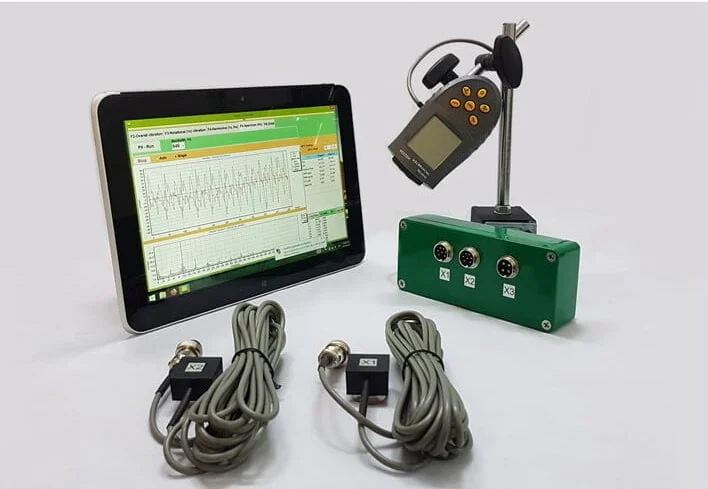
The full Balanset-1A kit is built for field work: open the case, mount the sensors, and you're running. The OEM set solves a different problem. It's the same measuring core, but without the case, and it's meant to be built in: into a soft-bearing balancing machine, a home-built stand, or old mechanics being retrofitted. Below we cover what's in the delivery, what the machine needs to provide, and how to verify the result on a reference rotor.
In stock
What you get
- Two accelerometers with cables, one per bearing
- Laser phase sensor (tachometer), working off a reflective mark on the shaft
- Two-channel USB module, with no power supply of its own
- Windows software, with an archive and printed reports
- Carrying case — the OEM version does not have one
- A Windows computer is not part of the kit
Request an invoice and order Buy on eBay Choose the complete kit or OEM
Sales information
- Seller
- AXILINE — Svitlana Gudyk · NIF / VAT PT265623375 · Rua das Colectividades 76 R/C ET, 4430-625 Vila Nova de Gaia, Portugal
- Price
- The figures are per unit. Portuguese VAT at 23 % is shown separately. For businesses in another EU member state with a valid VAT number the reverse charge may apply; the rate charged is stated on the invoice.
- Availability
- The instruments are in stock.
- Payment
- By invoice. Payment terms are set on the invoice.
- Shipping costs
- Shipping depends on the destination and the weight and is stated on the invoice or the quotation, before any payment. Apart from the price shown, nothing else is charged.
- Right of withdrawal
- A consumer generally has 14 days to withdraw from a distance contract under Portuguese Decree-Law 24/2014, without giving a reason.
- Legal guarantee
- For consumer movable goods, liability for lack of conformity generally runs for three years from delivery under Portuguese Decree-Law 84/2021.
- Consumer disputes
- CICAP — www.cicap.pt · CNIACC — www.cniacc.pt · Complaints Book — www.livroreclamacoes.pt
Full terms: cancellation, returns and withdrawal
Who Needs the OEM Kit
The OEM version fits cases where the instrument will live permanently inside a structure, not travel from site to site. The sensors stay mounted on the bearing supports, the tachometer sits on a bracket, and the computer stays by the machine. A case isn't needed for that kind of setup, so it's left out of the delivery, and the price is 240 EUR lower.
Repair Shops
Motor rewinding shops, pump and fan repair shops. Rotors are balanced after repair on your own soft-bearing stand, with no queue for a subcontractor and no transport.
Machine and Stand Builders
You build the mechanics yourself and buy the measuring part ready-made: a two-channel module, sensors, and software that calculates the correction masses. No need to develop your own electronics or your own software.
Retrofitting Older Machines
The bed and bearing supports of a Soviet-era or European machine often outlast its electronics by decades. The OEM core brings such a machine back into service: measurement, calculation, report.
Test Stands
Two-channel vibration measurement with the amplitude and phase of the once-per-revolution component — the vibration at rotating speed that unbalance produces — plus an FFT spectrum, time waveform, and measurement archive are useful even where balancing isn't the main task: on run-in and acceptance tests.
What's Included and How It Differs from the Full Kit
There's one difference: no case. Everything on the measuring side is identical to the full Balanset-1A that we ourselves carry out to on-site balancing jobs.
| Component | Balanset-1A (1975 EUR + VAT) | Balanset-1A OEM (1735 EUR + VAT) |
|---|---|---|
| Two vibration sensors (accelerometers) | Yes | Yes |
| Laser phase sensor (tachometer) | Yes | Yes |
| Two-channel USB module with preamplifiers, integrators, and an ADC | Yes | Yes |
| Windows software: balancing, spectrum, reports | Yes | Yes |
| Carrying case | Yes | No |
The computer isn't included: a laptop or a panel PC with Windows and a USB port will do. If you're not sure which kit to get, write to us with a description of the job — we'll advise before the purchase, not after.
Sources: Balanset-1A manufacturer specification
Standard Use Case: Soft-Bearing Balancing Machine
The soft-bearing (above-resonance) layout is the most accessible option for an in-house shop. The rotor rests on supports with a compliant suspension, whose natural frequency (the frequency at which the suspension oscillates on its own) is noticeably below the operating speed. At that speed, the supports oscillate freely, the accelerometers measure those oscillations, and the laser tachometer reads speed and phase from a mark on the rotor or the mandrel.
From there, the influence coefficient method takes over. The first run is the baseline measurement. Then a trial mass of known weight is placed at a known radius and another run is made; for two-plane balancing, the mass is then moved to the second correction plane (a different cross-section of the rotor where masses are attached) and one more run follows. The software calculates how your particular stand responds to unbalance and outputs the mass and angle of the correction weights. For rotors produced in a series, the coefficients are saved: the next rotors of the same type are balanced without trial runs, in a single measurement and a single correction.
We cover how to design the supports, bed, and drive for this layout in detail in our article on building a balancing stand yourself. It also includes a step-by-step acceptance procedure for the stand, covering both geometry and dynamics.
Sources: Balanset-1A manufacturer specification · Balanset-1A operation manual
What the Software Delivers When Retrofitting an Older Machine
An old machine with sound mechanics and dead electronics gains the functionality of a modern instrument once the OEM core is installed. Here's what you get in daily use.
- Single- and two-plane balancing using the influence coefficient method.
- Balancing using saved influence coefficients: series-production rotors with no trial runs.
- Trim balancing: refining the result in one extra cycle without recalculating from scratch.
- Index balancing with compensation for mandrel eccentricity (runout) — for rotors balanced on a mandrel.
- Splitting the correction mass across fixed positions: for impellers and rotor wheels where mass can only be added at a blade or in an existing hole.
- Calculating material removal by drilling: depth and diameter, as an alternative to a welded plate.
- Automatic check of trial mass validity: the software tells you whether the response differs enough from the baseline measurement.
- Calculation of permissible residual unbalance by G grades from ISO 21940-11, with a note on the applicable part and edition.
- Recalculating masses for other planes, a polar diagram, an FFT spectrum, and the time waveform on both channels.
- A measurement archive and reports: the result no longer lives only on an analog dial and in a notebook.
For the full breakdown of a retrofit — which components to check before buying, where a retrofit makes no sense, and how to accept the machine afterward — see our article on retrofitting a balancing machine.
Sources: ISO 21940-11:2016 · Balanset-1A operation manual
What the Machine Needs to Provide
The OEM core measures and calculates. The conditions for an honest measurement are created by your mechanics. Before ordering, check that your machine or stand design provides the following.
- Sensor locations: rigid, clean-faced mounting spots on the bearing supports, one per support, with a permanent fixing and a fixed measurement direction.
- A mark for the laser phase sensor: a contrasting mark on the rotor or mandrel, in direct line of sight of the tachometer, one pulse per revolution.
- Stable speed: the drive holds the same rotational frequency from run to run. A variable-frequency drive is convenient but not mandatory, if the speed repeats without one.
- Operating speed above the resonance of the support suspension — essential for the soft-bearing layout.
- Repeatable rotor mounting: a fit on the supports or mandrel with no play, otherwise the phase will drift between runs.
- Safety: guarding around the rotating zone, an emergency stop, and protection against a trial mass flying off. Mount the trial mass so that it's guaranteed to stay in place at operating speed.
Setup Procedure and Verification on a Reference Rotor
- Step 1
Agreeing on the Configuration
Send us a photo of the machine or a sketch of the stand, the type of supports, and the mass and speed of the rotors you plan to balance. We'll confirm whether the OEM kit fits your setup, or tell you honestly that it isn't the right tool for the job.
- Step 2
Mounting and Connection
Mount the accelerometers on the supports, the tachometer on a bracket with a clear view of the mark, connect the USB module to the computer, and install the software. The wiring diagram is in the manual; we provide remote support for specific questions.
- Step 3
First Balancing Run
Take a rotor, record the baseline measurement, apply trial masses plane by plane, and the software calculates the influence coefficients and correction masses. For series production, you save the coefficients.
- Step 4
Verification on a Reference Rotor
This is the key step that separates a working stand from a good-looking piece of hardware. You place a known trial unbalance on the already-balanced rotor: mass and angle recorded in advance. The system should show that same unbalance — matching in magnitude and angle, repeatably from run to run. Until this check passes, it's too early to trust the results.
- Step 5
Operation and Reports
You balance, save the measurements to the archive, and print reports showing residual unbalance and the tolerance for the selected G grade.
Sources: Balanset-1A operation manual · ISO 21940-11:2016
Honestly: What the OEM Kit Doesn't Fix
A measuring system doesn't fix mechanics. If the stand is poor, new electronics will only show, more precisely, how poor it is.
- Play and wear in the machine's bearing supports: the phase won't repeat, and the influence coefficients won't compute properly. Fix the supports first, then add the electronics.
- A weak or cracked bed: the structure's own resonances corrupt the measurement at operating speed.
- Vibration from the drive and belt transmission passes into the supports and overlays the rotor's signal.
- Drifting speed: without a repeatable rotational frequency, there will be no repeatable measurements.
- A bent or run-out mandrel: index balancing compensates for its eccentricity, but a bent mandrel shaft calls for a repair, not a setting.
- The machine's accuracy class. A claim like ‘this stand balances to G1.0’ needs a verified procedure behind it: a reference rotor, a known trial unbalance, repeatability, and the minimum achievable residual unbalance on your particular mechanics. The instrument calculates tolerances to ISO 21940-11, but the class itself is confirmed only by testing the whole stand. For flexible rotors, a different logic applies — ISO 21940-12.
Sources: ISO 21940-11:2016 · ISO 21940-12:2016
Price, Support, and How to Order
Balanset-1A OEM costs 1735 EUR + VAT; the full kit with the case is 1975 EUR + VAT. You can buy directly from AXILINE or through our store on eBay.
Support is handled by the engineers who design and build the Balanset instruments and use them for on-site balancing themselves. That means a question about sensor mounting or choosing correction planes gets answered by someone who did it by hand last week. We advise on configuration before the purchase and on setup afterward.
For a precise answer on your case, send us a message on WhatsApp at +351 931 831 229 or email axilinegeral@gmail.com: a photo of the machine or a sketch of the stand, the type of supports, and the mass, diameter, and operating speed of the rotors you're planning to balance. We'll tell you whether the OEM kit fits and what to fix in the mechanics before installing it. We're in Vila Nova de Gaia (Porto), and we work across Portugal; for updates, follow us on Instagram @axiline.pt.
Sources: Balanset-1A manufacturer specification
Frequently asked questions
How does the Balanset-1A OEM differ from the full kit?
Only in not having the carrying case, and in price: 1735 EUR + VAT versus 1975 EUR + VAT. The sensors, USB module, and software are identical. If the instrument will stay permanently on the machine, you don't need the case.
Will the OEM kit work with a hard-bearing (below-resonance) machine?
The standard application is soft-bearing, i.e. above-resonance, machines. If you have a hard-bearing setup, or you're not sure which type your machine is, write to us with a photo and a description before buying — we'll tell you honestly whether the kit fits your case.
Can the OEM kit also be used for on-site balancing?
Technically yes: it's the same instrument, and it fully handles balancing a rotor in its own bearings. But there's no case in the delivery, so you'll need to arrange your own protection for the sensors and module during transport. For regular field work, the full kit makes more sense.
Do I need a variable-frequency drive?
What's required is a stable, repeatable speed; how you achieve that is a question for your own mechanics. A VFD is convenient: it brings the machine to the same speed on every run and lets you steer clear of resonance zones, which matters when working from saved influence coefficients.
The instrument displays a G accuracy grade — can I state that to customers?
The software calculates the permissible residual unbalance by G grades from ISO 21940-11 and compares the result against it. But the machine's own accuracy class as a piece of equipment is confirmed through a procedure on a reference rotor with a known trial unbalance, plus a repeatability check. Without that verification, claiming a class isn't accurate.
What computer do I need to run it?
A computer with Windows and a USB port: a laptop or a panel PC in the machine's cabinet. The software is included in the delivery, and the module connects via USB. The computer itself isn't included in the kit.
Related content
Balanset-1A instruments: the kit, the OEM version, and how to order
The complete Balanset-1A kit costs 1975 EUR + VAT, and the Balanset-1A OEM version without the case costs 1735 EUR + VAT. The kit includes two vibration sensors (accelerometers), a laser phase sensor, a two-channel USB module with preamplifiers, integrators and an ADC, Windows software, and a case. The instrument balances in one and two planes using the influence-coefficient method. You provide your own Windows laptop. You can buy directly from AXILINE or through our shop on eBay. The instruments are in stock.
On-site rotor balancing, in the machine's own bearing housings
On-site balancing means the rotor stays in the machine. We fit two accelerometers (vibration sensors) on the bearing housings, aim a laser phase sensor at a reflective marker, take the initial vibration reading, run one or two trials with a weight of known mass, calculate the correction mass and angle, fit the weights and measure again. You get a report with the figures before and after. A typical visit takes a working day; vibration diagnostics with a report costs 300 EUR per unit, balancing adds from 250 EUR, and the minimum invoice per visit is 500 EUR.
Articles on balancing and vibration
Written by the people who do the work on site: how to measure, how to read the numbers, when balancing fixes it and when the problem is something else.
Describe your equipment and the problem
We'll answer your questions, clarify the details, and let you know what's needed for an estimate and a visit.