Balanset-1A instruments: the kit, the OEM version, and how to order
The Balanset-1A is a portable two-channel kit for balancing rotors in their own bearings — that is, right on the machine, without removing the rotor. Two-channel means the instrument measures vibration on two bearings at the same time. The complete version costs 1975 EUR + VAT, and the OEM version without the transport case is 1735 EUR + VAT. Below we go through what's in the case, what the software does, how OEM differs from the complete kit, and how to place an order. And upfront, we'll tell you when buying the instrument isn't worth it, and a site visit is the better deal.
Your own instrument or a site visit: the choice, without the sales pitch
Let's start with an uncomfortable question, because it saves you money. The instrument is a one-time purchase, but the skill of telling unbalance apart from shaft misalignment and resonance only comes with practice. If you'll only balance twice a year, by the third time your fitter will have forgotten which way the angle is measured, and the first unusual rotor will turn into a round of trial and error with the weights.
Count the cost of the task, not the cost of the case. The complete kit costs roughly as much as three to four visits under package S (550 EUR per machine up to 15 kW or 50 kg, diagnostics included). If you have a dozen rotors like that a year and they're all similar, your own instrument pays for itself quickly and takes waiting for a contractor out of the repair schedule. If it's a single but critical machine, and the cause of the vibration still isn't understood, it's more sensible to start with a visit and diagnostics rather than a purchase.
We're the engineers who design and manufacture the Balanset instruments, and we balance with them on site ourselves, so there's no point for us selling an instrument that will end up sitting in a cupboard.
- One to three balancing jobs a year on non-critical machines: a visit is cheaper, and the skill won't build up regardless.
- The cause of the vibration hasn't been established: measurement and diagnostics first, a purchase decision second. Balancing doesn't cure shaft misalignment, loose fixings or support resonance.
- You need bearing-fault detection and high-frequency diagnostics: that's a job for a vibration analyser with an acceleration channel, not a balancing instrument.
- There's no one to take this on. The instrument doesn't solve a staffing problem.
- You balance regularly, not once a year, and there's a specific person on your shift who will pick up the case.
- The rotors are similar in type: fans, induced-draft fans, pump impellers, pulleys. Saved influence coefficients (the recorded response of a specific machine to a trial weight) cut repeat jobs down to a single run.
- You're a repair organisation and need your own reports and independence from someone else's schedule.
- Downtime on the machine costs more than the instrument, and responding within the hour matters more than the price of the kit.
- You don't need field work — you need a measurement core for a balancing machine or test rig.
A sensible middle path: buy the kit and order a visit for the first machine at the same time. Your fitter carries out the first balancing job with their own hands, alongside our engineer. By the end of the day you have a balanced machine, a trained person, and a sample report. We've put a detailed breakdown of the criteria for choosing an instrument in a separate article on how to choose a balancing instrument and vibrometer.
Sources: Balanset-1A manufacturer specification
What's included in the Balanset-1A kit
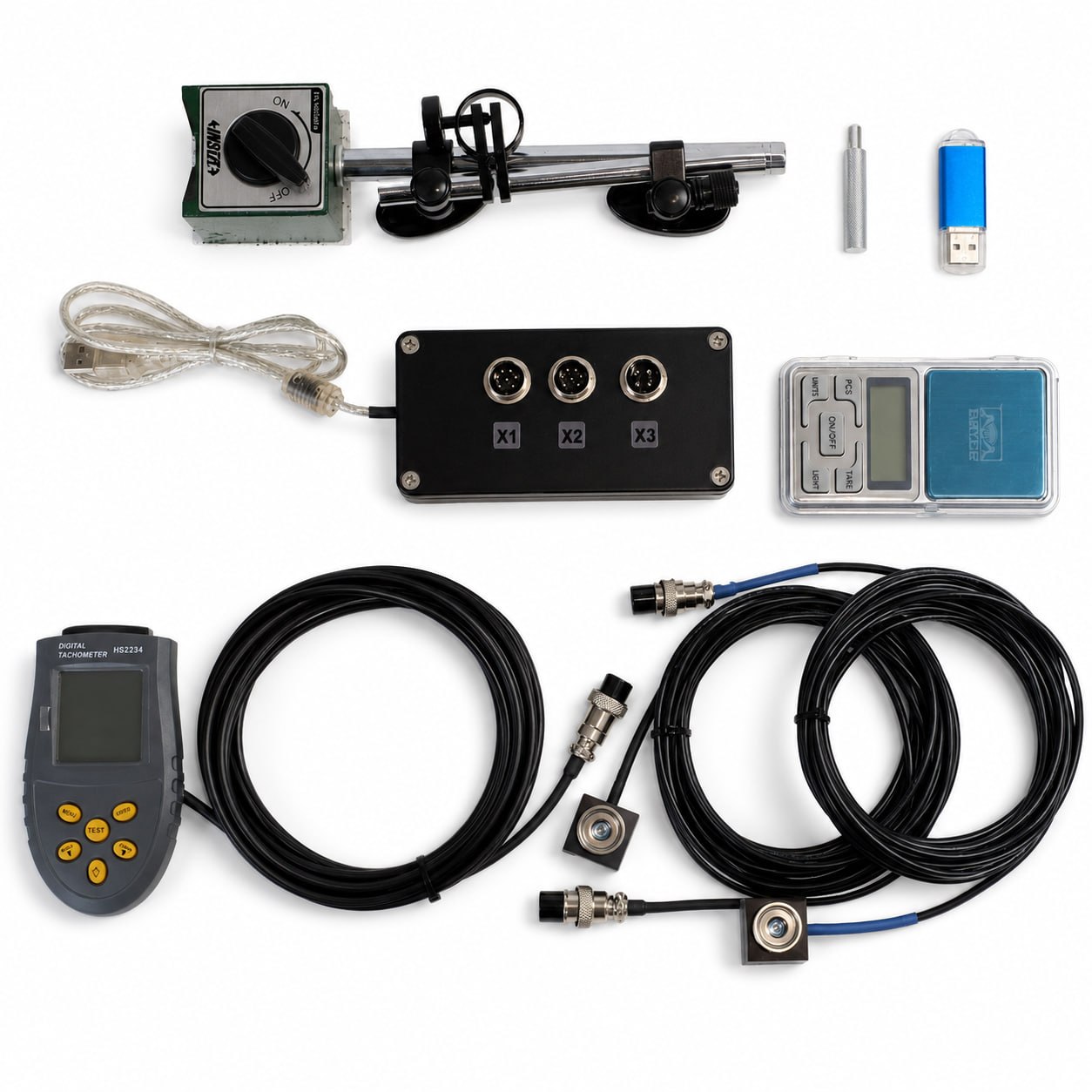
The kit is built around one task: arrive, mount the sensors on the bearing housings, measure the amplitude and phase of the running-speed component on both bearings at once, and calculate the correction masses. The running-speed component is the vibration at the rotor's rotational frequency — the exact thing unbalance creates. Phase is the angle that shows where the rotor's 'heavy spot' is. There's nothing extra in the case, and everything is powered from the laptop's USB port.
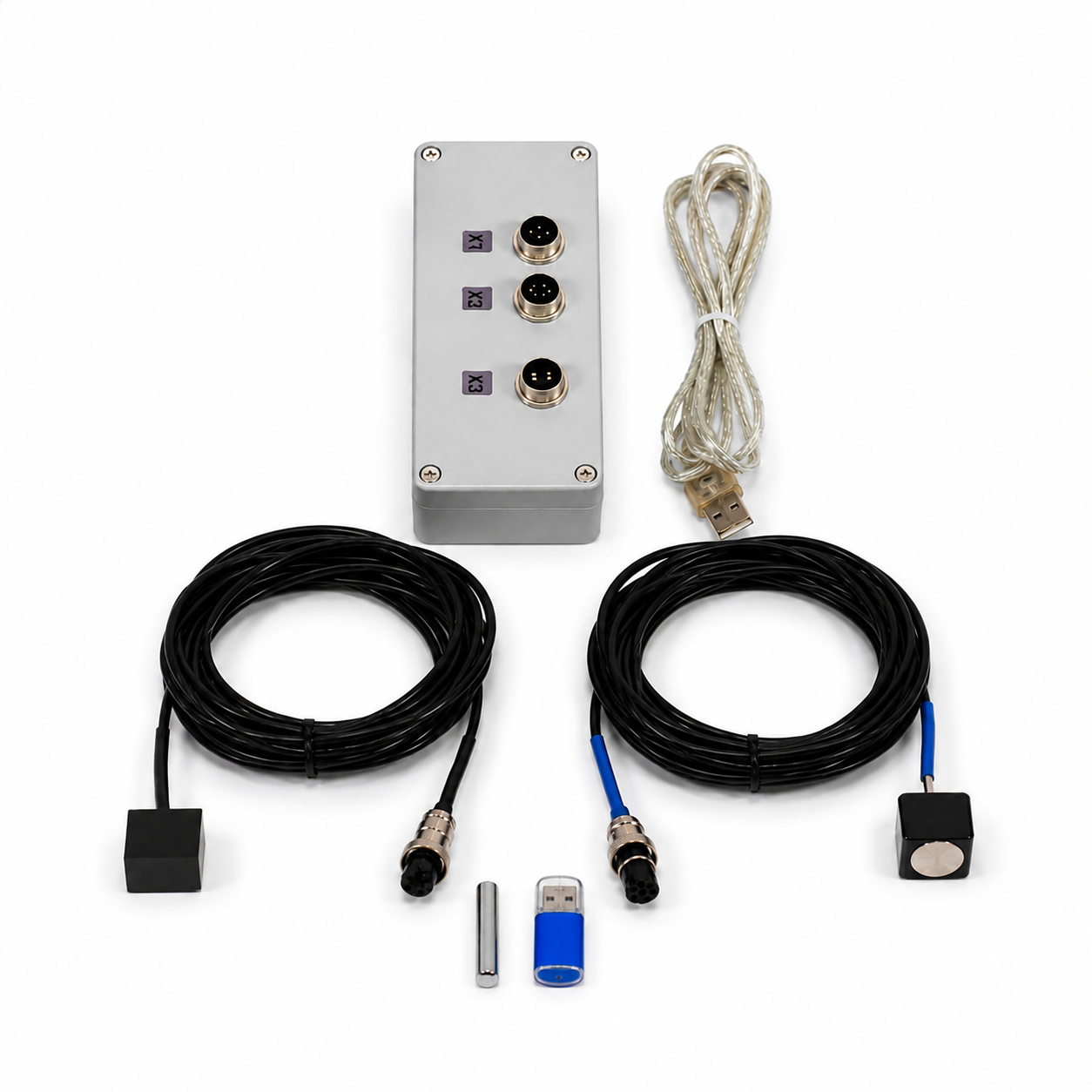
- Two vibration sensors (accelerometers). One for each bearing housing. Two channels aren't just for convenience: without measuring both bearings at the same time, you won't see the couple component of unbalance (where the 'heavy spots' at the two ends of the rotor are offset in opposite directions), and you won't get reliable influence coefficients.
- Laser phase sensor (tachometer). Works off a reflective marker on the shaft. This is what extracts the 1x component from the overall vibration and sets the reference point for the weight's installation angle.
- Two-channel USB module with preamplifiers, integrators and an ADC (analog-to-digital converter). Conditions the signal from the accelerometers, integrates acceleration into vibration velocity, and digitises both channels in sync. Needs no separate power supply.
- Windows software. Guides the operator through the runs, calculates the correction, keeps an archive, and prints reports.
- Transport case. Needed where the kit is carried around the site and driven from job to job. Not included in the OEM version.
The laptop isn't included in the kit. That's a deliberate choice: you install the software on the computer you already have, and don't pay for hardware you don't need.
Sources: Balanset-1A manufacturer specification · Balanset-1A operation manual
What the software does
The hardware in instruments of this class is broadly similar; the real difference in day-to-day use comes down to the software's functions. Each one either saves you a run or removes a source of operator error.
Measurement
Running speed, amplitude and phase of vibration velocity. The software shows both the overall vibration and the 1x component separately. This is the first diagnostic question on site: if the overall level is several times higher than 1x, unbalance isn't what's driving most of the vibration, and it's too early to balance.
Balancing in 1 and 2 planes
The correction plane is the cross-section of the rotor where weight is added or removed. The influence-coefficient method: an initial run, a trial weight, a calculation, a check run. For two planes there are two trial runs. The instrument checks on its own whether the trial weight was well chosen — that is, whether the response changed enough for the calculation to be reliable.
Spectrum and time waveform
The FFT spectrum and the time waveform let you see what's happening besides the running-speed component: harmonics, blade-pass frequency, and outside sources. That's enough for a quick check before balancing.
Weights where you can actually fit them
Fixed-position mode outputs not an abstract angle but blade or hole numbers, with the mass split across the two nearest positions. There's a drilling-correction calculation for when metal is removed rather than added. No protractor, and no errors in which way the angle is measured.
Repeat jobs
Saved influence coefficients remove the trial runs on the next balancing job for the same machine. Trim balancing calculates a small top-up weight to add to what's already fitted, instead of redoing the job. Index balancing cancels out arbor eccentricity (runout) for rotors balanced on an arbor rather than on their own shaft journals.
Tolerances and recalculation
Calculates the permissible residual unbalance under the G grades, with the caveat that the applicable part and edition of ISO 21940-11 should be checked. Recalculates the computed masses for other correction planes from entered distances and radii, for when you physically can't reach the plane you need.
Polar plot
A vector picture instead of a column of numbers. You can see straight away where the vector moved after the trial weight, and whether the process is converging. One glance at the plot often catches an error in the angle direction.
Archive, reports, manual entry
Every job gets its own folder with a run log, charts and a report file. Manual entry of amplitudes and phases lets you recalculate the correction from data taken by another method.
Sources: Balanset-1A operation manual · ISO 21940-11:2016
Balanset-1A OEM: how it differs and what it's for
OEM is the same measurement chain, supplied without the transport case, for 1735 EUR + VAT. The logic is simple: if the sensors sit permanently on the machine's supports and the computer lives in a cabinet, you don't need a case and there's no reason to pay for one.
This version has two standard applications. The first: building it into your own balancing machine or test rig as the measurement core. The second: retrofitting an existing soft-bearing (above-resonance) machine whose mechanics are still sound but whose electronics are outdated or dead.
There's a physical limitation here that's worth stating honestly before you buy. Accelerometers measure the movement of the support, not the force in a rigid connection. So the machine's supports need to visibly oscillate under the action of unbalance. For a soft-bearing (above-resonance) setup that's normal. For a hard-bearing machine with force transducers, this substitution isn't suitable.
If you're retrofitting an existing machine, see our separate breakdown on retrofitting balancing machines: it covers reworking the supports, sensor mounting spots, the drive, and metrological acceptance. If you don't have a machine yet, and you have a lot of similar rotors, read the article on building a balancing rig yourself, which covers the bed, the support suspension, and checking it against a reference rotor with a known trial unbalance.
- Batch balancing of similar rotors in a workshop: saved influence coefficients bring it down to one run per rotor.
- Electric motor repair and rewinding: balancing armatures and rotors after repair, on your own rig.
- Manufacturing impellers, fan wheels and pulleys: checking residual unbalance before shipping.
- Training and laboratory rigs, where you need a proper measurement section without the transport packaging.
Sources: Balanset-1A manufacturer specification · Balanset-1A operation manual
Complete kit versus OEM: comparison table
| Feature | Balanset-1A | Balanset-1A OEM |
|---|---|---|
| Price + VAT | 1975 EUR | 1735 EUR |
| Transport case | yes | no, supplied without a case |
| Measurement chain | 2-channel USB module with preamplifiers, integrators and an ADC | the same |
| Sensors | 2 accelerometers and a laser phase sensor | the same |
| Windows software | full version, no reduced functions | the same |
| Balancing in 1 and 2 planes | yes | yes |
| Typical use | field visits, balancing in the machine's own bearings | built into a machine or rig as the measuring system |
| Sensor mounting | portable, moved from machine to machine | permanent, on the machine's supports |
| Workstation | ready out of the box | you assemble it: brackets, cabinet, computer |
| Machine restriction | none | soft-bearing (above-resonance) types only |
| Availability, lead time, warranty | confirmed when you order | confirmed when you order |
The price difference reflects the case being left out. If you need a non-standard configuration for a specific rig, send us the parameters: we'll agree the exact scope of supply before issuing an invoice.
Sources: Balanset-1A manufacturer specification
What you need to prepare on your end
The instrument isn't self-sufficient, and it's better to know that in advance, not in a boiler room on a Friday evening. The list is short and inexpensive, but without it, the work will stall.
- A Windows laptop with a free USB port. The module is powered over USB, so no separate outlet is needed. If the mains supply is poor quality, run from the laptop's battery.
- A reflective marker on the shaft for the laser phase sensor. The reflective tape is a consumable — keep a supply on hand and cut the marker to the same length from one machine to the next.
- Sensor mountings and spots for them. A magnet needs a clean, flat surface, free of paint build-up and rust. A threaded stud mount gives a more honest signal at high frequencies, but needs a hole in the bearing housing.
- Correction weights and a way to fix them: bolts, clamps, welding. Scales with a fine enough graduation to weigh your weights.
- The place and the authority to stop the machine. Balancing means several runs, and each one is coordinated with the operator.
- Safety measures: start-up lockout, guards, protection against a weight coming loose. Check the correction mass is secure before every run-up.
- Someone who's accountable for the result. The instrument calculates the correction, but the decision — balance now, or fix the mechanics first — is made by a specialist.
Sources: Balanset-1A operation manual
Training and support
The software is designed for an operator with no specialised vibration training: it guides you through the runs and works out the solution itself. The real difficulties don't start in the interface — they start in diagnosis. A classic case: the overall vibration is three times the running-speed component, the operator dutifully fits the weights, and nothing changes, because the cause is shaft misalignment or loose fixings.
That's why we offer advisory support based on your specific measurement picture. Send us the 1x values and phase on both bearings, the spectrum, and a description of the machine, and we'll work out whether it's unbalance or something else, and what to do next.
The fastest way to get the process up and running is to combine the purchase with a visit for your first machine. Our engineer works on your equipment, your person does everything by hand, and at the end you're left with a balanced machine and a sample report to model your own on going forward.
Sources: Balanset-1A manufacturer specification
How to buy: prices, payment and VAT
- 01
Tell us what you're balancing
Machine type, rotor mass and size, running speed, whether it's overhung (the impeller sits outside the bearing span) or between bearings (mounted between the supports), access to the correction planes, and how many machines like this you have. For a rig, add the support layout and the drive. From this data we'll tell you whether the Balanset-1A fits your task, or whether a site visit makes more sense.
- 02
We'll help you pick a version
The complete kit in a case for fieldwork and going from machine to machine. The OEM version without the case for building into a machine or rig. If you're unsure, describe the task, and we'll suggest an option with a reason behind it, not just the pricier pick.
- 03
Invoice and prices
Balanset-1A 1975 EUR + VAT, Balanset-1A OEM 1735 EUR + VAT. All prices are shown + VAT. The payment terms are fixed in the invoice. Availability, delivery times and warranty terms are confirmed when you order — we won't promise them upfront.
- 04
Or order through eBay
AXILINE has a shop on eBay. This is convenient if you'd rather buy through a marketplace with its own payment and buyer-protection rules. In that case, the terms and timelines are set by how the specific order is placed.
- 05
First run and support
Install the software on your laptop, connect the module over USB, and prepare the marker and the mounting spots for the sensors. If something doesn't add up on your first machine, write to us — we'll work through your measurement picture.
All prices on this page are shown + VAT. Site-visit work is priced separately, by packages based on rotor size, with a minimum invoice per visit of 500 EUR and payment of 50% in advance.
What to send and how to reach us
So the conversation is specific rather than just 'how much does the instrument cost', send us a short set of data. That's usually enough for a substantive answer the same day.
We work out of Vila Nova de Gaia near Porto and travel across all of Portugal. If you're torn between buying and booking a visit, just say so — we'll work out both options using your own numbers.
- Type of equipment, and exactly what's rotating: impeller, fan wheel, drum, pulley, armature.
- Rotor mass and running speed. If there are several speeds, give the range.
- Rotor layout: overhung or between bearings, and whether both correction planes are accessible.
- How many machines like this you have, and how often you balance them.
- What's already been measured: vibration velocity values, the spectrum, photos of the machine and the bearing housings.
- For a rig: the support layout, the drive, the range of rotors, and the required G grade.
Phone and WhatsApp: +351 931 831 229. Email: axilinegeral@gmail.com. Instagram: @axiline.pt. Address: Rua das Colectividades 76 R/C ET, 4430-625 Vila Nova de Gaia. Write to us on WhatsApp with a photo of the machine — it's the fastest way to get a specific answer.
Frequently asked questions
How much does the Balanset-1A cost, and is VAT included?
The complete kit costs 1975 EUR, and the OEM version without the transport case costs 1735 EUR. Both prices are shown + VAT; the tax is added at the applicable rate when the invoice is issued. We fix the payment terms in the invoice, and confirm availability, delivery times and warranty terms when you order.
How does OEM differ from the complete kit?
By being supplied without the transport case. The measurement chain, sensors and software are the same, with no functions cut. OEM is chosen when the sensors will sit permanently on the machine's supports and the computer will live in a cabinet: a case is superfluous in that setup. We agree the exact scope of supply for a specific rig before the invoice.
Do I need a separate laptop, and will a tablet work?
A laptop is needed, and it's not included in the kit. The software runs on Windows, and the measurement module connects and is powered over USB, so a tablet on a different operating system won't work. The instrument needs no separate power supply, and if the mains quality is poor, the manual recommends running from the laptop's battery.
Can the instrument be used as a balancing machine's measuring system?
Yes, that's a standard application. There's one restriction: the machine must be soft-bearing, meaning above-resonance, with supports that visibly oscillate under the action of unbalance. Accelerometers measure the movement of the support, not the force, so this substitution isn't suitable for a hard-bearing setup with force transducers. We've covered the details in the articles on retrofitting machines and on building a rig yourself.
Will the instrument detect bearing faults?
No, and we won't promise that it will. The Balanset-1A handles balancing and shows the spectrum so you can assess the vibration picture, but bearing diagnostics lives at high frequencies and needs an analyser with an acceleration channel and envelope analysis — a specific method for picking out impacts in a bearing. Assess the machine's general condition by zone from the overall vibration, according to the applicable part and edition of ISO 20816.
Can I order a site visit first and decide about buying afterwards?
That's exactly what you should do if you're balancing for the first time or the cause of the vibration hasn't been established. A visit gives you the measurements, an answer to 'is it unbalance or shaft misalignment', a balanced machine, and the chance to see the instrument working on your own equipment. After that, the purchase decision takes five minutes, with no promises from anyone else needed.
Related content
Balanset-1A OEM: Measuring System for a Balancing Machine
Balanset-1A OEM costs 1735 EUR + VAT and differs from the full kit at 1975 EUR + VAT only in not including the case. The electronics, sensors, and software are the same: two accelerometers, a laser phase sensor, a two-channel USB module, and Windows software. The standard use case is as the measuring system of a soft-bearing (above-resonance) balancing machine — whether commercially built, home-built, or being retrofitted.
On-site rotor balancing, in the machine's own bearing housings
On-site balancing means the rotor stays in the machine. We fit two accelerometers (vibration sensors) on the bearing housings, aim a laser phase sensor at a reflective marker, take the initial vibration reading, run one or two trials with a weight of known mass, calculate the correction mass and angle, fit the weights and measure again. You get a report with the figures before and after. A typical visit takes a working day; vibration diagnostics with a report costs 300 EUR per unit, balancing adds from 250 EUR, and the minimum invoice per visit is 500 EUR.
Articles on balancing and vibration
Written by the people who do the work on site: how to measure, how to read the numbers, when balancing fixes it and when the problem is something else.
Describe your equipment and the problem
We'll answer your questions, clarify the details, and let you know what's needed for an estimate and a visit.